
Experience-Driven Design
Why You Can’t Train Innovation. You Have to Design for It.

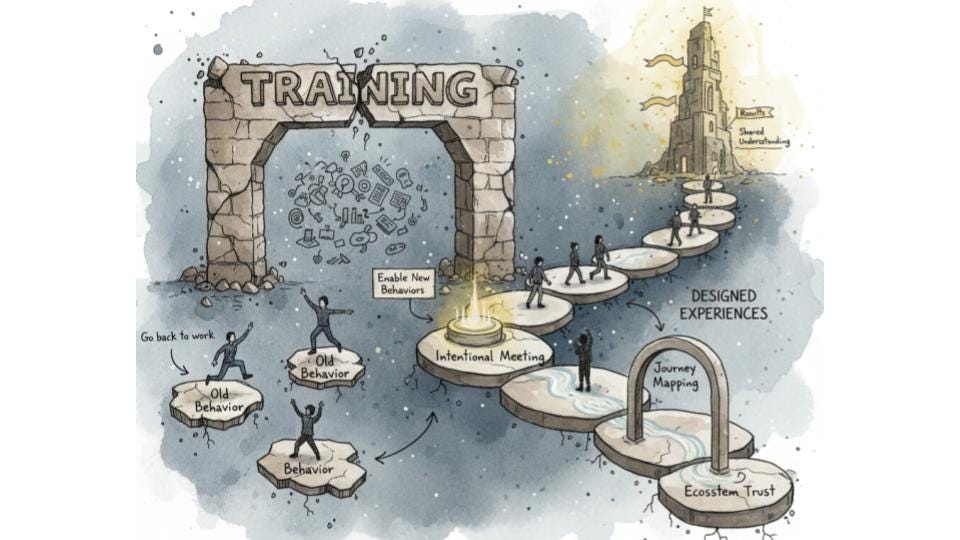
When Perfect Execution Produces Zero Results
Early in my career, I became a trainer for design thinking, agile, and product principles. I followed the approaches I’d been taught to run workshops, explain frameworks, send teams back to work. They left excited and energized. But when I stayed on to coach those same teams, I noticed something troubling: very little got adopted in practice. It was too easy to just “go back to work.”
The problem wasn’t the quality of information. I’d experienced this failure myself years earlier when I was sent to external training that used mock scenarios completely out of context from my actual work. When I returned and tried to apply it, I struggled—no one else had the shared experience. I was alone trying to implement new approaches in a system built for old ways.
You can’t train people into new behaviors. You have to redesign the experiences and systems they work within. Training provides information. Adoption requires designing how people actually work especially when that work involves multiple stakeholders who need shared understanding to make progress together.
This realization became even more critical when I started working on innovation adoption. Most innovation programs are designed around introductions and one way communication. Most people do not actually like the pitch experience especially not the innovators forced to compress their technology into five minutes nor the corporate stakeholders trying to evaluate complex solutions in artificial settings.
So why do we still do it? Who is it for? Does it actually achieve an outcome for as many people as it should?
Pitch events can be executed perfectly with a venue secured, agenda packed, attendees registered but they produce minimal results because they’re not designed for the actual outcome that those pitching are hoping for: discovering technology that is worth investing money and time to adopt. That requires a completely different experience. However, if the outcome was to excite a bunch of people about some cool stuff, well, then maybe it achieved its goal.
The Execution Trap: Why Organizations Don’t Design Experiences
Most organizations have never considered that every interaction including meetings, presentations and programs is an experience that should be designed for a specific outcome. It shouldn’t be limited to workshops and events.
I’ve watched teams return from intensive training and continue working exactly as before. The training was excellent, the content valuable but without designed experiences that make new behaviors natural, training becomes another checked box.
The default organizational behavior is execution: schedule the meeting, create slides covering all the information, plan the logistics. Everything gets done. But here’s what gets missed: organizations think they can achieve different results through training, telling people to behave differently, or implementing new processes. You can’t just tell someone to “be” a different way.
Most organizations apply experience design only to products and services. They invest in UX research, journey mapping, and interface design for customers. But they never apply those principles to how they work internally or engage with customers.
That’s a massive missed opportunity, because designed experiences are the mechanism for behavior change which is what organizations actually need.
What Product Teams Already Know (But Organizations Don’t Apply)
Good product teams have spent decades perfecting experience design principles. They understand you can’t force users to behave a certain way. You design experiences that make desired behavior natural and easy.
User experience design operates on clear principles: understand user goals, map their journey, identify enabling touchpoints. Design interactions that build capability progressively, then test and iterate. Every button, screen, and transition is intentional. Nothing is there just because “we always do it that way.”
Customer journey mapping visualizes the entire experience arc. Product teams ask: what does the user need at each stage? What capability are we building? What behavior are we enabling? How will we know this touchpoint succeeded?
Apple extended experience design beyond the interface to their retail stores. Every element designed to create specific experiences that reinforce behaviors. They didn’t just think about the iPhone interface; they thought about the entire customer experience.
Here’s the translation most organizations miss: these aren’t just “product methodologies.” They’re principles about human behavior and how designed experiences enable change. They apply just as powerfully to organizational interactions, internal operations, and business partnerships.
When corporations and innovators work with us, they’re coming because current behaviors aren’t producing results. Usually, they want technology adoption, but existing ways of working make that impossible. Training won’t fix it. Telling people to “be more innovative” won’t fix it. Designing experiences that naturally shift behaviors does.
Designing for Behavior Change, Not Just Information Delivery
Let me give you a specific example of experience design in action.
When my team designs events for innovation adoption, we start with a behavior change challenge: corporate executives need to shift from judging technology (their job to make decisions quickly) to exploring opportunities before deciding. Those are opposite behaviors.
You can’t tell an executive, “Today, don’t judge—explore instead.” That contradicts every professional instinct. So we design experiences where exploring becomes natural. We consider: when are people presenting versus talking? How do we balance structured activities with open space? How do we design the room? When do we create informal conversation opportunities? How do we keep focus without constant email checking?
Every element creates an environment where exploring becomes easier than judging, where curiosity gets rewarded, where the experience guides behavior.
This is the fundamental difference between training innovation and designing for it. Training says: “Here’s how to explore opportunities. Now go do it.” Design creates conditions where exploring becomes the natural response. Training adds information. Design changes actual behavior. That’s why sending executives to a workshop on “collaborative innovation” rarely works, but designing an event where collaboration is the easiest path forward actually does.
This scales to individual interactions too. One underrated experience we’ve designed is the selection interview for innovators. I’ve heard countless horror stories about how startups get treated in selection interviews. Organizations fall into judgment mindsets rather than opportunity exploration.
In my work, I remind myself: I’m recruiting these innovators. I must sell them on working with me. So the entire experience is intentionally designed from first interaction to invitation with that mindset. I map the journey, examine outcomes at each touchpoint, and verify we are creating the intended experience through thoughtful sequencing and medium selection.
Result? Even without immediate opportunities, innovators stay engaged for future collaboration.
This thinking applies to internal team dynamics too. I don’t just “have meetings” with those I work with. I ask: what outcome are we designing for? How will we know we achieved it? Does every element drive toward that outcome? How are we facilitating the conversation? What tells us people are engaging?
The principle: every interaction either reinforces old behaviors or enables new ones. Design intentionally, or accept whatever happens by default.
Start Here: Making the Unconscious Conscious
Here’s where to start: map existing experiences internally to make the unconscious conscious. You already have experiences in your business—meetings, onboarding, project kickoffs. Understand what they actually are before adapting them.
Or start smaller. Take an upcoming presentation or meeting and assess:
Before creating anything:
What’s the goal? What behavior change or understanding am I enabling?
How will I know people are engaging?
What tells me we achieved the outcome?
As you design:
Does each element drive toward the goal?
Will this format enable the behavior I want?
What experience am I creating?
Am I designing around people’s needs or my assumptions?
After the interaction:
Did we achieve the intended outcome? How do we know?
What behaviors did we observe?
What would we change based on what we learned?
This assessment-and-adaptation cycle should sound familiar—it’s the Adaptive Innovation principle from my previous article in action. These principles aren’t isolated. Trust enables you to design experiences that ask people to behave differently. Adaptation improves those experiences based on what you learn. And intentional experience design is what makes behavior change possible in the first place.
Key insight: you can’t force behavior change through training or telling. Often, designing the environment and interactions is all you need. Make the desired behavior easy and natural.
For larger, multi-stage experiences, programs, partnerships and major initiatives map them visually. Only by visual mapping can you see complex interactions you need to design for and identify touchpoints that build the capability you’re aiming toward.
In my work, I stay focused on what matters: people, their experience, and outcomes, not deliverables.
A Better Way of Working
Applying experience design organizationally isn’t just “more effective”. It’s fundamentally better for everyone.
It’s more human because it’s rooted in human-centered design. It’s more enjoyable because you’re mindful of “why” and intentional about “how.” It keeps you focused on people and outcomes instead of deliverables and checked boxes.
Organizations keep investing in innovation training while wondering why behavior doesn’t change. They send people to workshops, bring in speakers, and distribute frameworks. Then they’re surprised when everyone returns to business as usual. The problem isn’t training quality. It’s that training alone can’t change behavior.
When you apply experience design organizationally: meetings become purposeful, presentations create clarity, programs build capability, interactions create trust.
Most importantly, you stop telling people to change and start creating conditions where change becomes natural. That’s the power of designed experiences. They shift behaviors without force, which shifts results without resistance.
In my work, I focus on building platforms for innovation versus repeatable programs. I have frameworks to start, then practices to adapt and innovate around each unique context. Innovation doesn’t happen by standardizing.
Think about your organization. How many meetings this week were “just executed” versus intentionally designed? How many presentations covered information without enabling understanding? How many programs run because “that’s what we do” instead of being designed for specific outcomes?
Product teams figured this out decades ago: experience design isn’t optional for user engagement. The same is true organizationally: experience design isn’t optional if you want people to engage differently, behave differently, and produce different results.
This is Article 3 of 5 proving that methodologies built on learning and adaptation—often left only to product teams—deliver transformative results when embedded as organizational operating principles.
Look at your upcoming week: which interaction could benefit from experience design thinking—and what outcome are you actually trying to achieve?